Self-assessment:
Human led, AI enabled organizational design
Design organizations that can adapt as fast as your business. Connect strategy, structure, workforce data, and AI-powered insights to model change, test scenarios, and build organizations ready for what’s next.
Trusted by global enterprises









Building an organization that can adapt
Most organizations redesign only when pressure hits. Intentional enterprises treat organization design as a continuous capability, using data to see what is changing and why, before decisions become urgent. Structures cannot stay static. Shifting markets and expectations create pressure long before it is visible. A redesign that takes six months every few years cannot keep pace. You need clarity that lets you adapt by design rather than necessity.
Organizational design connects strategy to structure. It brings together systems, roles, skills, performance, culture, and processes to create an organization that can move with intent.
Want to know more?
How mature is your organizational design?
The realities of organization design
Designing any organization means managing constant movement. Each change affects how people work, how value flows, and how strategy gets delivered. This creates recurring challenges:
- People and politics can focus design individuals rather than business needs.
- Fragmented data makes it hard to see where risks, gaps, or opportunities lie
- Design process is often mistaken for Org charts when true design needs principles, organizational system thinking, and testing options before change reaches people

Organizational design is driven by the business strategy and operating context, and requires holistic thinking around systems, structures, people, performance measures, processes, culture, and skills.
Naomi Stanford, Organization Design Consultant
How Orgvue helps
Whether you are responding to immediate pressure or building long term capability, Orgvue gives you the intelligence to see impact before you decide and to model transformation before you commit.
With Orgvue, you can analyze, design, plan, and monitor your organization in one platform so you can:

See your organization clearly
Bring together data from across the business and reveal how work, roles, and performance connect. Spot risks, gaps, and inefficiencies that are otherwise hidden.

Model scenarios quickly
Use interactive visuals and AI enabled insights to explore options grounded in evidence. Understand how changes to structure, skills, cost, or location will affect your organization.

Engage stakeholders with confidence
Share clear, compelling visuals that explain not just what is changing but why. Build alignment earlier and reduce uncertainty.

Track change over time
Monitor progress against your design principles. Identify where plans are drifting, where capacity is strained, or where new opportunities are emerging.
Seeing the organization as a connected system
Successful design starts with understanding your organization as a living system rather than a static structure. People, roles, and work are constantly shifting and depend on the wider ecosystem in which the organization operates. To manage this complexity, you need to see how work flows, where activities combine to create value, and how changes in one area affect performance elsewhere.
Orgvue visualizes these relationships so you can understand workforce demand, compare it with supply, and adjust the flow of work as circumstances change.
The objective of organization design is to ensure organizations have the right people, with the right skills, doing the right work in the right way in the right numbers with real alignment to achieve strategic objectives.
Rupert Morrison, Data Driven Organizational Design
Henshaw Assistant

Ask, and your data answers
Henshaw Assistant brings your data to life, giving you instant clarity on your workforce.
Ask questions like:
- Which departments have an average span of control below my target of 6?
- In which departments are their “Data analyst” positions?
features and benefits
How Orgvue supports organization design
See how your organization really works
- Clean and organize messy data to reveal how work, roles, and performance move over time
- Spot where capacity is constrained, where skills are mismatched, and where management changes may affect results
- Gain clear, actionable insight to make intentional decisions grounded in evidence
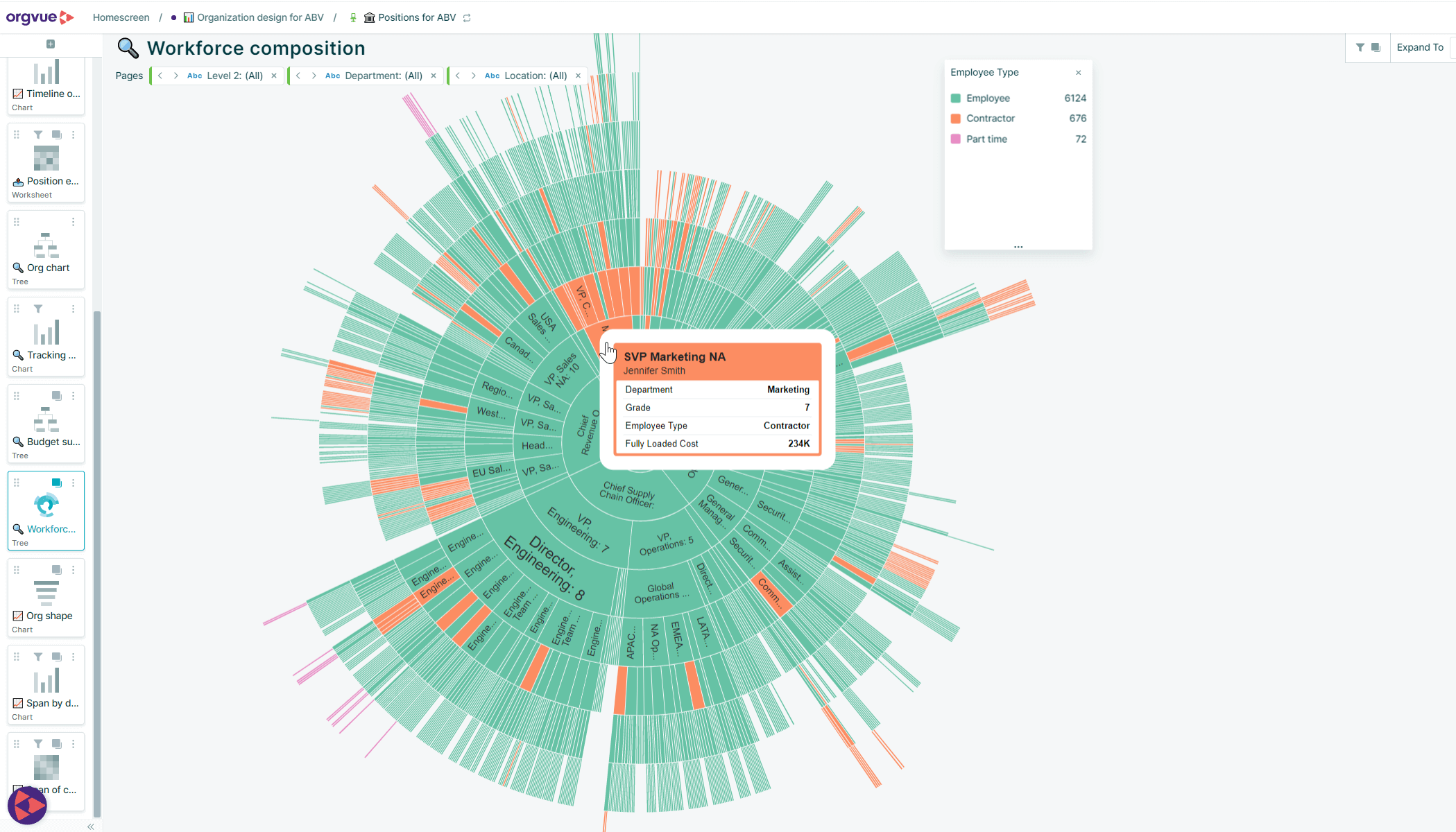
Screenshot from Orgvue platform of a sunburst graphic illustrating an organization broken down by employee type
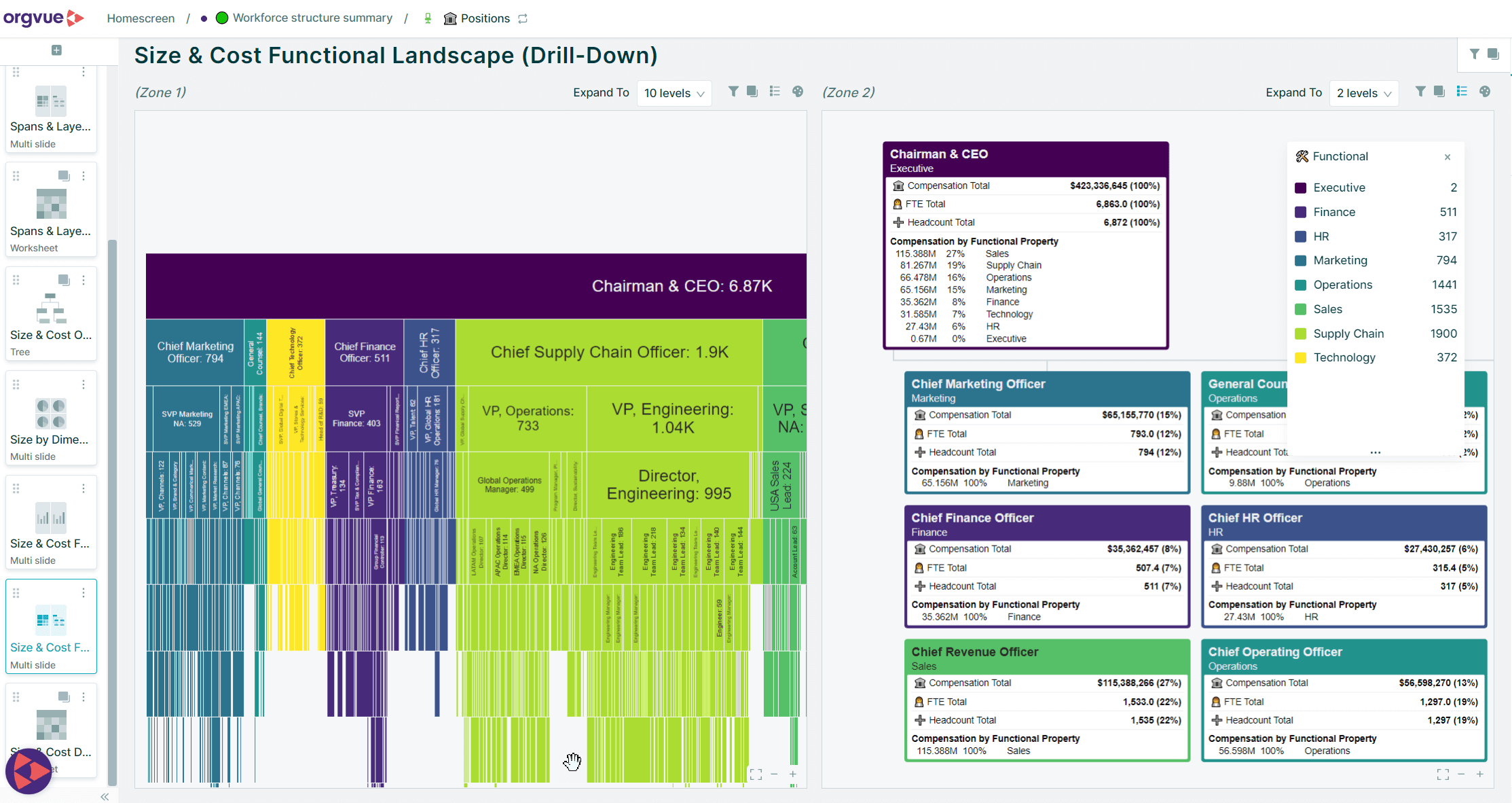
Using Orgvue to visualize the different departments
Using Orgvue to understand and analyze activities across the organization
Build a single view of your business
- Bring together data from across HR and the business to create one shared source of truth
- Use Henshaw AI to organize thousands of positions into a structured role architecture
- Apply solution packs to surface insights from high level trends to detailed patterns
- Colour code by location, grade, skills, or cost to highlight what matters
- Export visuals to share clear, aligned stories with stakeholders
Explore organizational health
- Use pre built visuals to examine key dimensions such as spans and layers, age and tenure mix, vacancies, skills supply, and representation
- Understand the impact of AI on roles, workloads, and the design principles shaping your organization
- Answer essential design questions including how many layers you have, where grades sit, and whether capacity is distributed as intended
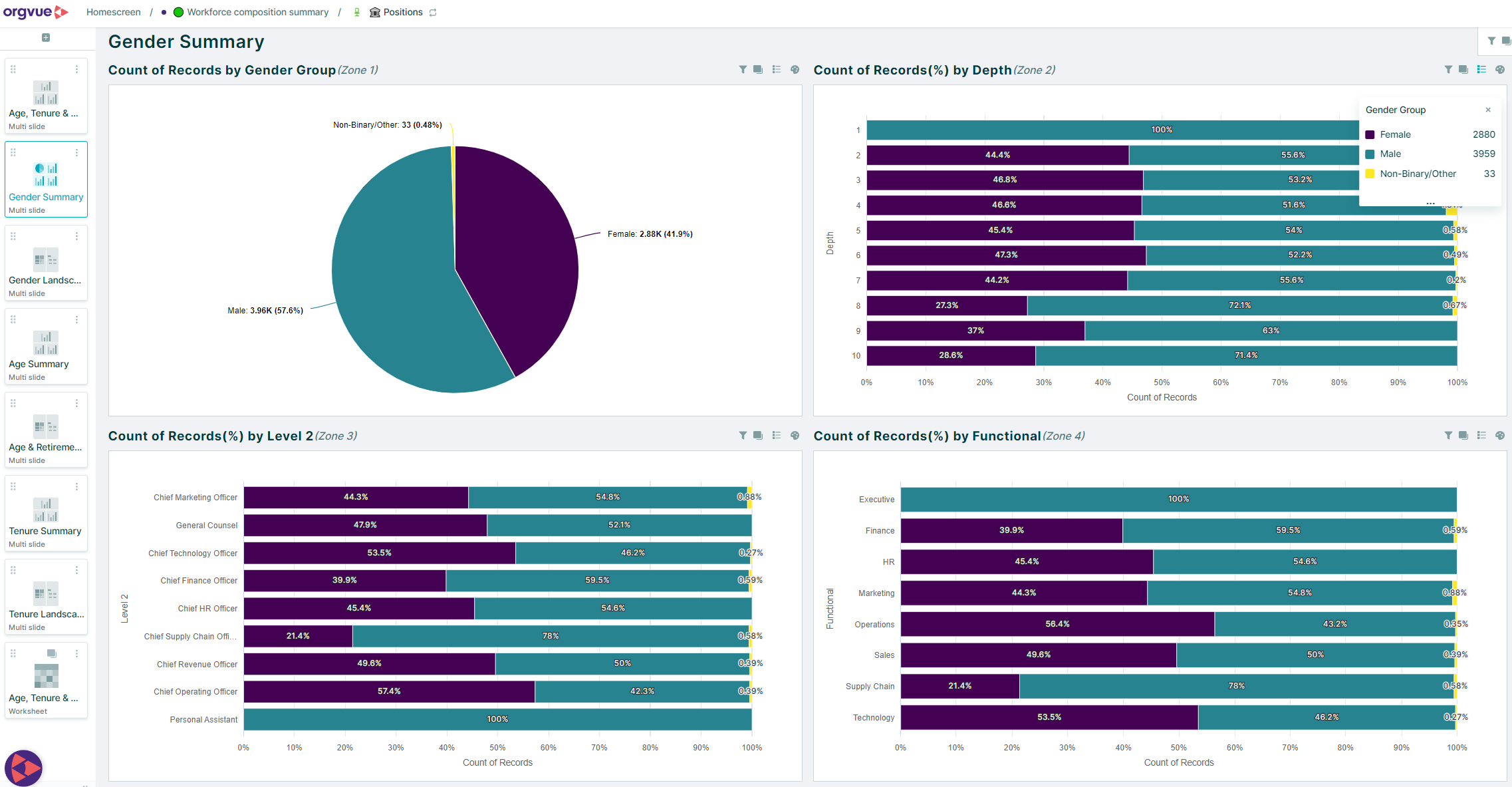
Orgvue graph showing the breakdown of diversity and inclusion on the platform
Easily model your future organization in Orgvue
Model future scenarios before you commit
- Drag and drop teams or roles to test structural, financial, and operational scenarios in minutes
- Assess the impact of relocating teams, shifting to remote work, centralizing functions, or outsourcing roles
- Explore where investment in AI would have the greatest effect on performance and cost
See your future state clearly
- Visualize the whole organization to check alignment with strategic goals
- Identify areas that need deeper analysis before changes reach people
- Create a future design that is resilient, transparent, and ready to evolve
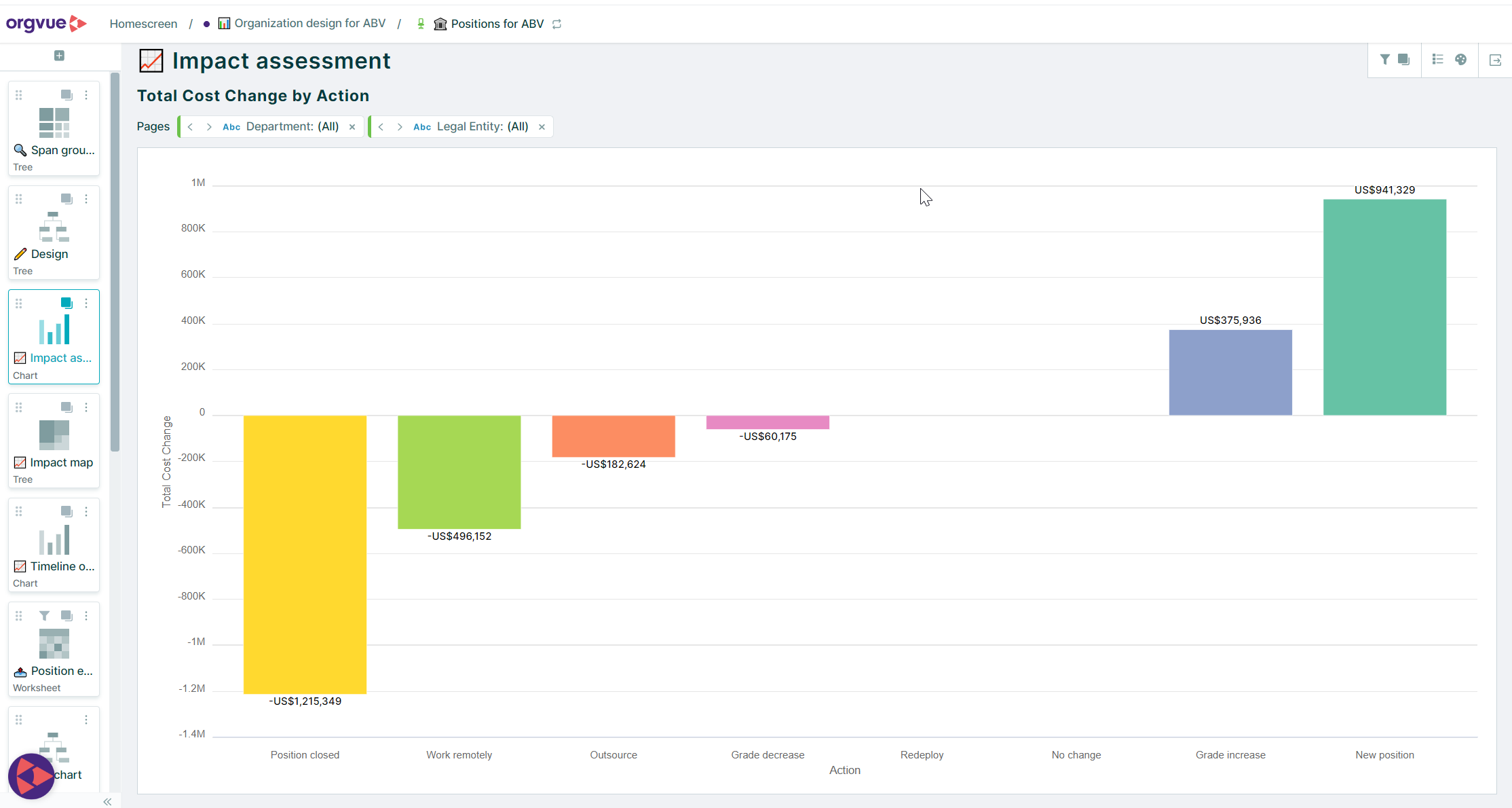
Screenshot of an Orgvue chart showing savings and expenditure by organizational changes
Organization design self assessment
In only one minute see your company’s capability compared with our industry benchmark in your free report with hints, tips, and recommended next steps.
Ready to see Orgvue in action?
In a personalized demo session, discover how Orgvue can help you:
- Understand workforce impacts before restructuring
- Compare multiple operating model scenarios
- Find critical skill gaps across the organization
- Align workforce plans to business strategy
- Accelerate AI workforce transformation
Trusted by global enterprises
“Orgvue’s automated role-clustering capability will save a huge amount of time in surfacing opportunities for organizational redesign, workforce planning, and cost reduction. What we’ve seen so far is truly game changing for design work.”
Stacy Anderson, Salesforce
Get your personalized demo
30-minute discovery call
Demo tailored to you
See our privacy notice. You can unsubscribe from marketing at any time by writing to us at [email protected].
Not ready for a demo? Explore more…



FAQ: Organizational Design
Organizational design is the process of aligning your structure, workforce, roles, skills, processes, and ways of working to your business strategy. Effective organizational design goes beyond org charts to ensure the right work is being done by the right people, with the right capabilities, in the most effective way possible.
The most effective approach starts with understanding how work, people, costs, skills, and performance interact across the organization. By combining workforce data, strategic objectives, and scenario modeling, leaders can evaluate multiple design options before making changes and ensure organizational structures support long-term business goals.
Organizational design often fails when decisions are driven by hierarchy, politics, or incomplete data rather than business outcomes. Common challenges include relying solely on org charts, overlooking how work actually flows through the organization, failing to test scenarios before implementation, and treating redesign as a one-off exercise rather than an ongoing capability.
Successful organizational design starts with a clear understanding of your current organization, followed by defining design principles, evaluating future-state scenarios, assessing impacts, and implementing change in a controlled way. Continuous monitoring is essential to ensure the new design delivers the intended business outcomes and adapts as conditions change.
Data-driven organizational design replaces assumptions with evidence. It helps organizations identify inefficiencies, uncover skills gaps, optimize spans and layers, evaluate costs, model future scenarios, and make more confident decisions about organizational change before implementing them.
While every transformation is different, most successful programs follow three core stages:
1. Understand the current state by analyzing workforce, skills, structures, and performance.
2. Design and test future-state scenarios aligned to business strategy.
3. Implement and monitor outcomes to ensure the organization evolves as intended and continues to meet changing business needs.
Organizations are not static structures. They are living systems where people, work, processes, skills, technology, culture, and performance continually influence each other. Changes in one area often create ripple effects elsewhere. Viewing the organization as a connected system enables leaders to understand workforce demand, anticipate impacts, and make better design decisions.
Organizations can measure design effectiveness through metrics such as spans and layers, workforce costs, productivity, skills availability, employee mobility, vacancy rates, management effectiveness, and strategic goal attainment. Continuous measurement ensures organizational structures remain aligned to business priorities over time.
Markets, technologies, workforce expectations, and business strategies constantly evolve. Organizations that treat design as an ongoing capability rather than a periodic exercise can respond faster to change, reduce transformation risk, and continuously optimize how work gets done.